Responding to Google Reviews: A Practical Guide for Business Owners
Your Google Business Profile is often the very first impression someone has of your business, before your website, before a phone call, before they walk through the door. Reviews are a big part of that impression, and how you respond to them is just as important as the reviews themselves. Every reply is public, permanent, and read by future customers. Think of each one as a small piece of brand-building.
Why your responses matter
- Future customers are your real audience. You're replying to one person, but dozens or hundreds of potential customers will read the exchange. They're judging how you treat people.
- Responses show you're active and attentive. A profile where the owner replies consistently signals a business that cares and is paying attention.
- Your tone is your brand. Warm, professional, and calm replies tell people what it feels like to work with you.
- Engagement encourages more reviews. When customers see that reviews are read and appreciated, they're more likely to leave one.
- A good reply can rescue a bad experience. Many unhappy reviewers will update their review, or at least soften their view, when they feel genuinely heard.
Ground rules for every response
- Respond to every review — good and bad. Not just the complaints. Silence on a glowing review is a missed thank-you.
- Respond promptly. Aim for within 24–48 hours. A quick reply shows you're engaged; a reply three months later looks like an afterthought.
- Use their name and be specific. "Thanks, Maria, so glad we could get your Spriter Van running a like a brand new one!" it beats "Thanks for your review!"
- Keep it short. Two to four sentences is usually right. Long replies read as defensive or scripted.
- Never copy-paste the same reply. Identical responses look automated and undercut the personal touch you're trying to build.
- Sign off personally. "— Sam, Owner" adds a human face to the business.
- Protect privacy. Never reveal details about a customer's order, appointment, account, or visit in a public reply — even if they shared them first.
- Proofread. Typos in a public reply will chip away at your credibility.
Responding to positive reviews
Positive reviews are your easiest brand-building opportunity — and the ones most often ignored.
- Say thank you, sincerely. Lead with gratitude.
- Reference something they mentioned. It proves you actually read it.
- Reinforce what you want to be known for. If they praised your attention to detail, echo it — that phrase now sits on your profile for others to read.
- Invite them back without being salesy.
- Skip the hard sell and keyword stuffing. Replies crammed with promotions or SEO phrases read as inauthentic.
Example:
Thank you so much, Jordan! We loved working on your kitchen remodel, and it means a lot that the clean-up stood out to you, we treat every home like it's our own. Enjoy the new space, and we hope to see you again. — Alex, Owner
Responding to negative reviews
This is where your brand is truly tested. Readers aren't expecting perfection — they're watching how you handle imperfection.
Before you reply:
- Pause. Take a deep breath. Count to 100. Never reply when you're angry or hurt. Wait 24 hours, and have someone else read your draft.
- Look into it. Check what actually happened, get the facts straight before responding.
In your reply:
- Thank them and acknowledge the experience. "Thank you for letting us know" — even when it stings.
- Apologize for how they felt, without necessarily admitting fault on every detail.
- Don't argue, blame, or get defensive. Even if you're right, winning the argument publicly loses the audience.
- Briefly show what you're doing about it if there's a real issue ("We've since adjusted our scheduling process").
- Take it offline. Offer a direct way to connect: "Please reach out to me at [phone/email] so I can make this right."
- Keep it short and calm. One reply only, don't get sucked into a back-and-forth in public.
Example:
Hi Chris, thank you for sharing this, and I'm truly sorry your appointment didn't go as expected. That's not the experience we want anyone to have. I'd really like to hear more and make it right — please call me directly at [number]. — Sam, Owner
Avoid:
- "We have no record of you as a customer" (sounds accusatory, even if true)
- Sarcasm, ALL CAPS, or exclamation points in anger
- Long explanations of why the customer is wrong
- Offering refunds or discounts publicly (it can invite copycat complaints — handle it privately)
Tricky situations
- Mixed reviews (3 stars, some praise, some criticism): Thank them for the positives first, then address the concern constructively.
- Star-only reviews with no text: A brief thank-you still helps for positive ones; for low ratings, a short, polite invitation to share more privately works well.
- Reviews you believe are fake, spam, or abusive: Don't accuse the reviewer publicly. Use Google's option to flag/report the review for violating policy. You can still post a calm, neutral reply in the meantime ("We're unable to find a record of this visit, but we'd welcome the chance to talk — please contact us at…").
- A reviewer updates their review after you resolve it: Reply again with a short thank-you. These turnaround stories are some of the most powerful content on your profile.
- Remember: You can't delete a review you simply disagree with. Your response is your tool.
Building a healthy flow of reviews
- Ask happy customers directly — in person, on receipts, in follow-up emails, or with a QR code linking to your review page.
- Make it easy: share your direct Google review link.
- Ask everyone, not just happy customers. Selectively asking only satisfied customers ("review gating") goes against Google's policies.
- Never pay or offer incentives for reviews (discounts, freebies, contest entries), and never write reviews for yourself or ask friends and staff to post fake ones. This violates Google's policies and can lead to reviews being removed or your profile being penalized — and in the US, fake reviews also run afoul of FTC rules.
- A few honest negative reviews are normal. A profile with only perfect 5-star reviews can actually look less trustworthy.
Use reviews as feedback
Reviews are free customer research. Once a month, skim through them and ask:
- What do people consistently praise? (Lean into it — that's your brand.)
- What issues come up more than once? (Fix them — that's your opportunity.)
- Is the way customers describe us the way we want to be described?
Quick checklist before you hit "Reply"
- Did I use their name and mention something specific?
- Is my tone warm, calm, and professional?
- Is it short (2–4 sentences)?
- Did I avoid sharing any private customer details?
- For a complaint: did I acknowledge, apologize, and offer to take it offline?
- Would I be proud if a future customer read this?
- Did I sign off with my name?
Bottom line: Dont' be a jerk! Every review is a conversation happening in front of your future customers. Respond to all of them, respond with care, and let your replies show people exactly what kind of business you are
A Real World Example
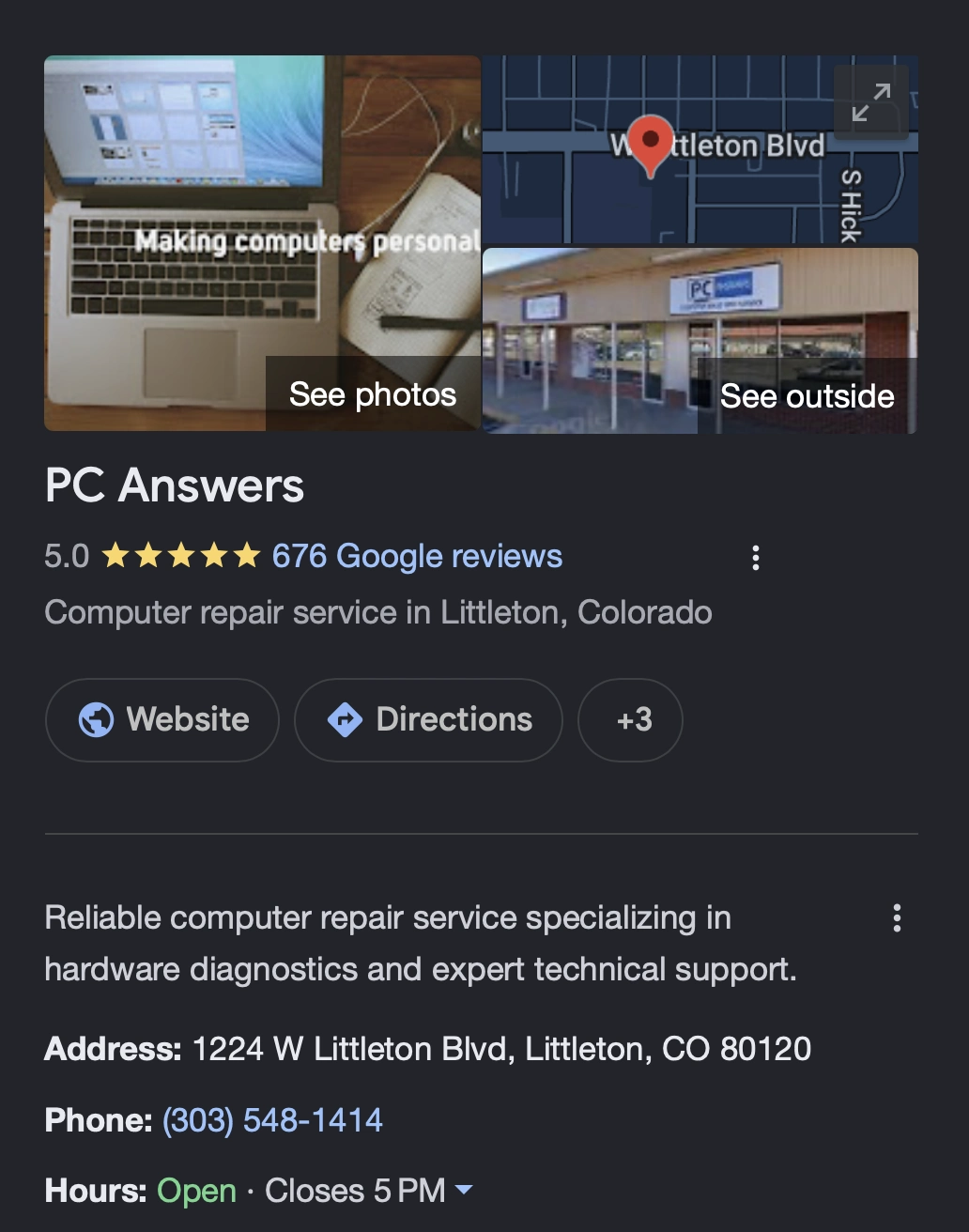
My friend Michael from PC Answers in Littlon, Colorado is doing a solid job with his Google Reviews. He personally answers every single one, good or bad.